


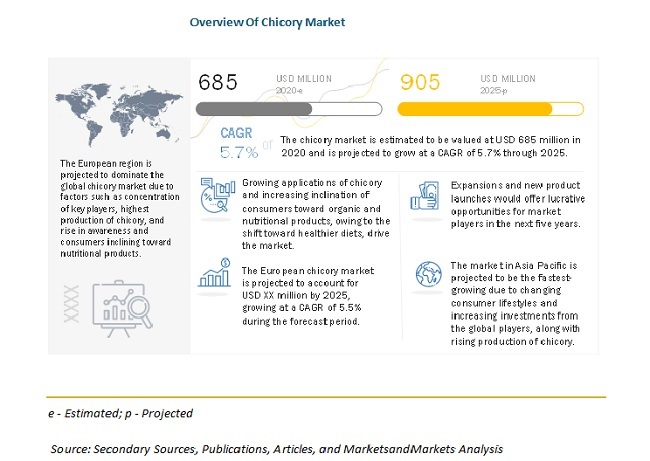
According to MarketsandMarkets, the global chicory market size is estimated to be valued at USD 685 million in 2020 and is projected to reach USD 905 million by 2025, recording a CAGR of 5.7%, in terms of value. Rising prices of coffee beans along with increasing consumption of coffee, is navigating the coffee and other food & beverage manufacturers to adopt to chicory ingredient, as a cheaper substitute to coffee. Also, high medicinal values and health benefits associated with the consumption of chicory, is expected to further propel the market. Furthermore, easy cultivation process of the crop and rising number of new entrants in the market, is substantially snowballing the growth prospects.
COVID-19 Analysis:
Owing to the COVID-19 pandemic, the consumption of ready-to-mix and ready-to-drink beverages has witnessed a substantial increase. This largely includes drinks such as coffee, juices, and flavored milks. Due to the lockdowns and curfews imposed by various regional and national governments, the work-from-home culture experienced a boost. Due to the increased work-life stress and busier lifestyles, the population across the globe started increasingly consuming coffee in order to have increased concentration and focus on work. To cater to this growing demand, the coffee manufacturers boosted/enhanced their production capabilities and volumes. Owing to this, the consumption of chicory has increased simultaneously, as it is used as a blend in the majority of the ready-to-mix and ready-to-drink coffee products. As it is a caffeine-free, healthier, and low-cost substitute to coffee, manufacturers have largely started including it in the coffee processing process. Consumers are also leaning toward chicory blends to minimize health risks associated with caffeine. Thus, the pandemic has bolstered the growth prospects for chicory, not only being a cheaper substitute for coffee, but also due to its health benefits offerings.
Download PDF Brochure: https://www.marketsandmarkets.com/pdfdownloadNew.asp?id=122013320
Restraints: High dependency on mainstream products such as coffee
Chicory, though popularly known to be a caffeine-free substitute to coffee, does not offer the same organoleptic characteristics. The dark coffee flavor and aroma are unique to the coffee bean. Chicory coffee, on the other hand, has a slightly woody bitter taste with a nutty, and sometimes, herbal flavor. Some roasts of chicory even have traces of slightly tart fruits such as cherries. Coffee is enjoyed for many reasons by people across the globe for its flavor, ritual, memories, emotion, and of course, the stimulation it delivers.
Most coffee enthusiasts find it difficult to replace coffee with any other beverage. Over time, the coffee drinker begins to associate the taste and smell of coffee with positive mood changes and energy, enhancing their brain function on consumption.; this includes improved memory, mood, rise in energy levels, and improves general cognitive functions. Green tea is associated with enhancing body metabolism and, consequently, weight loss; black tea is associated with physical and mental robustness. Tea and coffee are also widely grown and harvested in several countries in large amounts. According to FAOSTAT, more the 100 million tonnes (~112 million tons) of coffee and 6.4 million tonnes (7.05 million tons) of tea were produced globally in 2018. The coffee and tea industries witness the easy availability of raw materials and cheaper products from the local and regional players. All these factors restrain the growth of the chicory product market across the world as their substitute.
Opportunities: Growth in applications of chicory across various industries
A variety of trends have driven the use of chicory root fiber not only in food & beverage applications but also in other areas like in dietary supplements, pet food, cosmetics, and pharmaceutical industries. In the food and beverage industry, one of the present significant trends is in sugar reduction. Chicory root fiber can assist with sugar reduction by helping with flavor and texture. Chicory leaves and roots have been used for salads and in the preparation of various innovative and tasty recipes. Chicory is a nutritional powerhouse, containing vitamin K, A, C, and a long list of the B group vitamins. It is an excellent source of minerals like manganese, copper, iron, and potassium. The roots of chicory contain inulin fiber, a type of prebiotic that promotes the growth of beneficial bacteria in the gut; this is used widely as a dietary supplement.
On the basis of application, the food & beverage segment is expected to hold the majority share and grow at the fastest rate in the global chicory market.
The chicory plant is quite versatile, and it has found its application in many areas; it is best known for its association with coffee. Chicory is primarily an organic and all-natural ingredient and a cheaper substitute to an array of ingredients in the food & beverage industry. It is mainly consumed as blends or alternative in caffeine-containing beverages such as coffee, which is largely consumed across the globe. The young leaves can be used in salads, and the root can be boiled and eaten like a vegetable. Thus, finding its most important and wide application in the food & beverage industry, the market is expected to grow at a substantial rate during the forecast period.
Speak to Analyst: https://www.marketsandmarkets.com/speaktoanalystNew.asp?id=122013320
The Europe region dominated the chicory market with the largest share in 2019, whereas Asia Pacific is expected to witness the highest growth rate.
The European market accounted for the largest share in 2019. According to FAOSTAT, Europe contributed to over 95.5% of the global production of chicory roots. According to the same data, Belgium is the largest chicory roots producing county in Europe, followed by France, the Netherlands, and Poland. Consumers of chicory in Europe witness a high preference for clean-label products due to the increase in awareness pertaining to the consumption of natural and free-from products. This, in turn, is projected to drive the chicory market in this region. The region also witnesses the concentration of maximum global players engaged in the manufacturing and marketing chicory products in the global market. Thus, the European region was the largest contributor to the global chicory market in 2019.
Asia Pacific is projected to witness a higher growth rate during the forecast period. This is attributed to factors such as untapped potential, growing awareness among the population, rising investments from the global key players, and increasing economic developments, among others. The densely populated countries in the region with higher risks of chronic diseases such as obesity and heart-related issues are expected to bolster the growth in demand for chicory. The growing food & beverage industry, along with the rising cultivation and production of chicory, is further driving the demand and growth prospects for the chicory market in Asia Pacific.
This report includes a study on the marketing and development strategies, along with the product portfolios of leading companies. It consists of profiles of leading companies, such as Cosucra Groupe Warcoing (Belgium), Delecto Foods Pvt Ltd (India), BENEO GmbH (Germany), Sensus (Netherlands), Leroux (France), Cargill Incorporated (US), Reily Foods Company (US), Pioneer Chicory (India), PMV Nutrient Products Pvt Ltd (India), Farmvilla Food Industries Pvt Ltd (India), Murlikrishna Foods Pvt Ltd (India), Starwest Botanicals (US), STOKROS Company Ltd (Russia), Nature’s Gold Production (Netherlands), Organic Herb Trading Co (UK), Narasu’s Coffee Company (India), NP Nutra (US), Shaanxi Sciphar Natural Product Co Ltd. (China), Jamnagar Chicory Industries (India), and Herbs & Crops Overseas (India).