


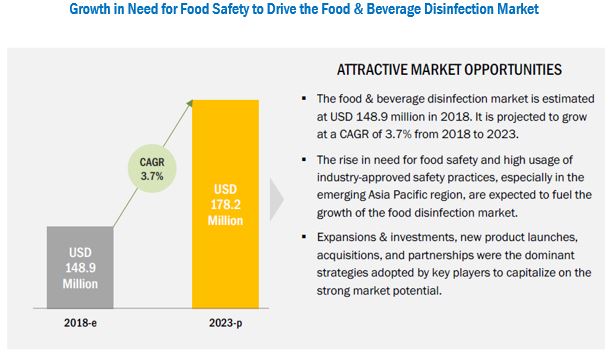
Food & Beverage Disinfection Market categorizes the global market by Type (Chemical (Chlorine, Hydrogen Peroxide & Peracetic Acid, and Ammonium), Technology (UV Radiation, Ozonation)), End Use, Application (Surface, Packaging, Processing Equipment), and Region. The food & beverage disinfection market was valued at USD 144.5 million in 2017; this is projected to reach a value of USD 178.2 million by 2023, growing at a CAGR of 3.7% from 2018. The basic objective of the report is to define, segment, and project the global market size for food & beverage disinfection technology and disinfectant chemicals on the basis of end use, application areas, type, and region. It also helps to understand the structure of the food & beverage disinfection market by identifying its various segments. The other objectives include analyzing the opportunities in the market for stakeholders and providing a competitive landscape of market trends, and to project the size of the food & beverage disinfection market.
For More details on this research, Request Free Sample Report
This report includes estimations of the market size in terms of value (USD million). Both, top-down and bottom-up approaches have been used to estimate and validate the size of the global food & beverage disinfection market and to estimate the size of various other dependent submarkets in the overall market. The key players in the market have been identified through secondary research, some of the sources are press releases, paid databases such as Factiva and Bloomberg, annual reports, and financial journals; their market share in respective regions have also been determined through primary and secondary research. All percentage shares, splits, and breakdowns have been determined using secondary sources and were verified through primary sources. The figure below shows the breakdown of profiles of industry experts that participated in the primary discussions.
To know about the assumptions considered for the study, download the pdf brochure
The key players that are profiled in the report include Evonik (Germany), Neogen Corporation (US), Solvay (Belgium), Stepan Company (US), FINK TEC GmbH (Germany), Entaco (Belgium), CCL Pentasol (UK), Xylem (US), Evoqua Water Technologies (US), Advanced UV (US), Halma (UK), Trojan Technologies (Canada), and Suez (France).