


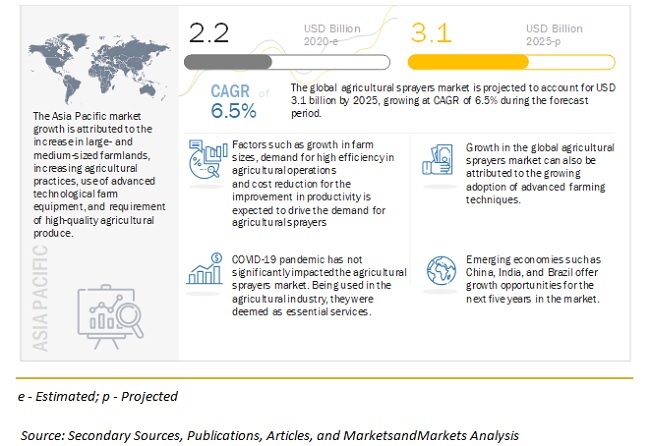
According to MarketsandMarkets, the global agricultural sprayers market size is estimated to be valued at USD 2.2 billion in 2020 and projected to reach USD 3.1 billion by 2025, recording a CAGR of 6.5% during the forecast period. Factors such as an increase in farm sizes, demand for high efficiency in agricultural operations, and cost reduction for productivity improvement are expected to drive agricultural sprayers' demand during the forecast period. Asia Pacific segment will dominate the market due to its increase in large- and medium-sized farmlands, increasing agricultural practices, and rising use of advanced technological farm equipment.
Drivers: Increase in focus on farm efficiency and productivity
Agriculture has traditionally been a risky economic activity, and farmers worldwide have been impacted by economic downturns and environmental shifts. The newer technology versions of agricultural sprayers have provided various benefits to the farmers, such as low cost, increased spray efficiency, safety, and less damage to the crops and environment. This is subsequently growing the demand for sprayers in the global market. Agricultural sprayer manufacturers are increasingly inclined to focus on enhancing farmers' capabilities and knowledge to make them more productive and help them compete in the market. Also, the increasing implementation of precision farming techniques has improved the potential of manufacturers of sprayers to make the agricultural steps more efficient and predictable.
Download PDF Brochure: https://www.marketsandmarkets.com/pdfdownloadNew.asp?id=46851524
Challenges: Increase in risk of spray drift
With the use of the innovative and technically advanced faster sprayers with higher application capacity, the rate of application of chemicals/pesticides is also increased. As a result, the chemical released per hour is comparatively higher in modern sprayers. The increasing trend of spraying during night time and the higher application of pesticides in the fields lead to the risk of spray drift due to surface temperature inversions at night. Due to this, volatile vapors can travel several kilometers, and it is impossible to predict their extent and damage. Drift pesticides are insidious threats to human health as well as wildlife and ecosystems in and around agricultural and even residential areas where harsh chemicals are used to ward off pests. The biggest risk from pesticide drift is to the human life settled near larger farms, which employ elevated spraying equipment for the application of chemicals.
By power source, the fuel-based sprayer segment is the fastest-growing segment in the market during the forecast period
Fuel-operated sprayers are most efficient due to their strong engine, capacity to cover large farm areas, and reduced human effort, but they also demand proper maintenance. For their running, all engines need fuel, air, and a proper system of ignition. Thus, in a petrol engine, clean petrol, clean air, and healthy ignition are essential. Fuel-based sprayers are used for high volume spraying.
Request for Customization: https://www.marketsandmarkets.com/requestCustomizationNew.asp?id=46851524
Asia Pacific is projected to account for the largest market share during the forecast period
The Asia Pacific market is estimated to account for the largest share in 2019. This is primarily attributed to agriculture, which is the major occupation in the region; it has a huge regional presence, including countries such as China, India, Australia, Japan, and the Rest of Asia Pacific. Thus, the increasing agricultural practices, use of advanced technological farm equipment, and requirement of high-quality agricultural produce are expected to drive the agricultural sprayers market in this region.
Key Market Players:
John Deere (US), CNH Industrial N.V. (UK), Kubota Corporation (Japan), AGCO Corporation (US), Bucher Industries AG (Switzerland), Mahindra & Mahindra Ltd. (India), Yamaha Motor Corp. (Japan), STIHL (Germany), EXEL Industries (France), AMAZONEN-Werke (Germany), BGROUP S.p.A. (Italy), Agro Chem Inc. (US), Boston Crop Sprayers Ltd. (UK), H&H Farm Machine Co. (US), Buhler Industries Inc. (Canada), AG Spray Equipment, Inc. (US), John Rhodes AS Ltd (UK), and H.D. Hudson Manufacturing Company (US).