


Let's consider several tips on how to choose CRM platform for real estate.
1.Don't let CRM services to trick you
Surely, there are lots of CRM platforms that are tailored to real estate activities. However, largely, they are not likely to meet some specific scenarios existing within your business. That's because developers simply cannot predict all of them, as well as how a separate real estate firm will operate.
So, it makes sense to use the CRM services of general-purpose having the same capabilities aboard, plus features of customization and integration that often overpass those proposed in dedicated solutions. This way, you can extend the capabilities of your CRM by using a proven platform instead of tailoring your business for a specialized one.
The thing is that any procedure connected with real estate is influenced by lots of legal and administrative obligations. The level of these operations can vary from federal to state or municipal levels. In the meantime, the regulations are pretty different depending on the locales of where the separate business is involved in.
Actually, the list of demands for each operation is pretty long and includes housing laws, lease languages, and so on. All of them can generally affect how the company does its business.
The factors mentioned above, call into question the possibility to create a dedicated full-scale real estate solution that's able to cover all the aspects of doing business in this sphere. So, the ordinary CRM for small business may serve as the CRM for estate agents.
2.Select a data-driven path
Another point to consider when choosing is how advanced CRM is when it comes to storing and processing of data. Depending on the kind of operation, you will be faced with the necessity to attach information about customers.
For smaller operations, several fields that will form the database in your solution will be enough. And for bigger ones you will probably have to deal with third-party services or sources to get your records or documents.
3.Access your CRM over multiple platforms
Whatever real estate operations that you lean forward, be it renting or selling, you should not underestimate the convenience of mobility. If you own a company, most staffers working there are always on the go. There is no need to look far - the sales staff is a great example. These guys may need to use their smartphones for updating some records in the CRM.
The solution you choose should correspond to the following criteria:
Desktops and mobility
Your CRM should support desktop operating systems, as well as the mobile ones preferred by your employees. Besides, they have to be equally supported. I mean, their interface along with functionality should be the same over desktop platforms, be it macOS or Windows. Certainly, mobile versions will differ from desktop ones but, nevertheless, they should feel and look the same when running on iOS and Android. In another case, your employees might need re-training. Besides, such a requirement can help you to distinguish a good quality CRM service from a poor one.
Cross-platform development unity
Let's start from the point that your team of developers should be capable of managing software equally (if it is necessary) regardless of the platform that it is working on. That way, if you require adjusting the software for specific needs, the customized changes should function on mobile platforms as well. Commonly, these changes imply adding some additional fields and automated workflow to your CRM. However, you may go much further in customization if you want and the flexibility of your CRM is capable of that. For this purpose, the code has to be responsive so that it could fit all the devices be it a smartphone or a laptop.
So, bear these two easy points in mind while choosing the CRM platform for your real estate business. Test it on all the devices it is going to be used on and involve your IT specialists in order to poke around everything connected with the customization capabilities.
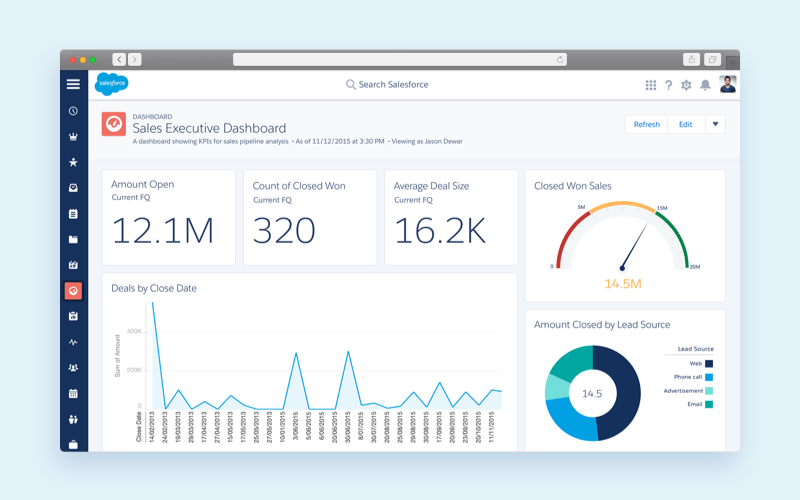
Salesforce CRM interface
4.Choose secure solutions only
A large number of CRM services are cloud-based. That's cost-effective due to the pricing model based on subscriptions, as well as convenient since you and your personnel can access the data from any device that has an Internet connection. However, that also means all your sensitive data isn't stored in a locked safe behind the picture in your office, but somewhere on a cloud.
Looking back at data that is usually collected from luxury renters or buyers before giving them the approval, it becomes understood why security is a really important thing. Tax returns, payment records, references - the list is long. I suppose it is pretty obvious that if this information leaks to the internet - a subpoena is guaranteed.
In order to avoid similar situations, do not ignore security issues in your CRM solution. All the content you see on the service's website or receive from a vendor directly are marketing-powered. They will claim that their service is as secure as actually possible. As a result, many customers take their word for it and continue considering other features just skipping the security one. Wrong! Take your time and discuss this with your IT personnel. That will provide you with a professional conclusion concerning one's service Internet security.
Find out whether your CRM vendor gives you an opportunity for choosing the place for storing. If so, it opens up good opportunities for data protection for your developers (encryption, data storage in multiple locations). However, in this case, be ready to discuss the changes with your CRM vendor since it may affect the pricing.
5.Keep in touch with customers
If the sale deal is closed that doesn't mean that your interaction with this customer is over. Yes, after a renter has signed the lease a certain part of the relationship is over, but the next part including operations related to property management is only about to begin. Moreover, it will stop only when the lease finishes.
Whatever software solution your company is using to satisfy the maintenance requests of renters, it should have an opportunity for being integrated with the CRM system you use. This way, your staff always knows what they are dealing with if it's time to renew a lease or a client decided to move into another property managed by your company.
Do not forget about your system of accounting that should be pretty good at data processing. That will be helpful in case of delayed rent payments, as well as damages to property. Probably, you will even require that your CRM could import and synchronize that data with the record made there. That fact may facilitate further cooperation with a customer.
So, consider CRM systems from different angles. Make sure it is flexible and allows you to edit the data stored there, as well as allows third-party services to access it.
Check out the comparison of CRM software appropriate for real estate underneath.
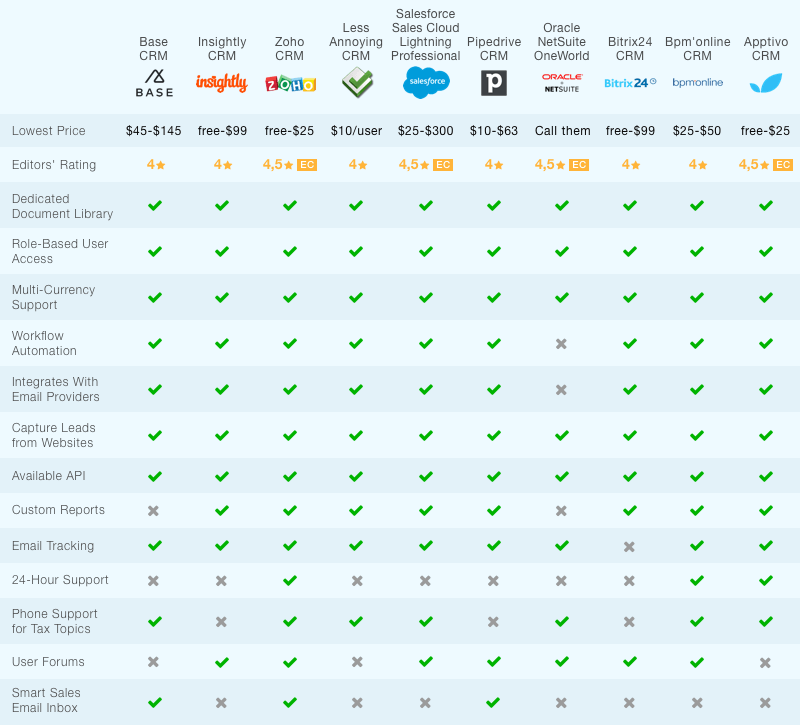
Real estate CRM comparison





