


“All Chinese people are good at Math.” Anyone who has any relation or interaction with a Chinese person might have heard something similar to the line above. Many may say this is a stereotype. Some may say there is some truth to this, but the arguments of this phrase is not to be fully discussed here. What is to be examined, however, education in China is leading Chinese students to dominate the competition in the United States.
Over the past 10 years or so, enrollment in Chinese pre-schools and primary schools have slowly increased. On the other hand, secondary education (college and university) have slowly dipped. Why? Judging from the data gathered below (figure 1) it can be inferred that more and more families believe it be essential for their children to receive some type of formal education (at least up until high school).

To address the increased enrollment in primary education, there has to be discussion based on Professor Emeritus, John L. Graham’s paper, “Trade Brings Peace: An Essay About One Kind of Citizen Peacebuilding” (Graham, 2012). One of Graham’s main takeaways in his essay is the fact that Chinese students have begun to learn English at the young age of six. Coupled with the fact that China’s urban population has been slowly growing, schools have become increasingly more accessible. This accessibility will and have allowed more Chinese families to encourage their children to enroll in school in order to learn English at a young age. Learning a second language at a young age is advantageous because a child is still capable of absorbing much information during the brain’s early developmental stages. Thus, this explains why pre-school enrollment has nearly doubled in only the last 9 years (2008–2017). Why are families so eager to enroll children in education and have them learn English? Although China is at pace to surpass the United States in terms of military power economic prosperity, English is still one of the world’s most commonly recognized and used languages (Knowpia, 2019). In addition, the culture that surrounds the English language is also quite pervasive. Take the KFC and McDonald chains around the world. Although their menus and writings may be Chinese in China, these fast-food chains represent the U.S.’s cultural and linguistic impact. It’s nearly impossible to escape the branded, American images of popular foods, snacks and restaurants. In a sense, if U.S. culture has ingrained itself into Chinese culture, then it would make sense to study the language of that pervasive culture to learn its successes (and mistakes).
However, if studying is so important, one may ask: why has the 2017 population for secondary education 1/5 less than the population in 2008 (seen from Figure 1)? The first explanation for this would be: if there is an increase in preschool and primary education, then it would be reasonable to assume, students seeking a university-level education would be placed under more competition. Of course, the ambitious goal for many striving students is a top level, world renowned University. Unfortunately, not everyone will be accepted. Those without a secondary education are then forced to find a job. The second explanation/alternative for the slight dip can be seen in Graham’s paper (2012) and a discussion post (Week 1: A New Chapter in U.S.-China Relations). Graham stated there were approximately 60,000 Chinese Students studying in American Universities. This was data conducted in 2012. In the readings and discussion post assigned for Week 1, the amount of Chinese studying in American grew to 300,000. From these figures alone, it can be inferred that increasing numbers of foreign Chinese Students will continue to take their secondary education to the United States. Thus, learning English at a young age allows the Chinese scholar an alternative or second pathway to find success in education.
The age at which Chinese are studying English is rather young, but as previously discussed, there exists a growing population and demand for Chinese students to study abroad in the U.S. This has varying implications for the current and future domestic and international situations within and without China. From within, Chinese citizens are able to observe, absorb and interpret American culture at a young age because they have included English in school curriculum. In the long run, this gives Chinese Citizens an advantage when it comes to negotiation, discussion, or just general knowledge. In the future, when they mature from being six-year-olds to businessmen negotiating a million dollar contract with an American representative, their tacit knowledge of the English language will have given an edge in closing the deal. Politically, this also gives China a domestic advantage. When diplomatic relations drive Americans to interact with Chinese, the Chinese politician with an average education will be able to understand English conjecture with relative ease. On the other hand, Americans will most likely require a Chinese translator (unless Chinese Mandarin becomes a required language in schools in the United States or that politician knows Mandarin).
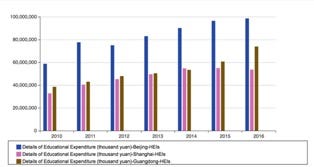
As the English language continues to be taught, more and more Chinese citizens will become accustomed to the language. When this happens, the English taught will become increasingly difficult, resembling English taught in the U.S., resulting in a demand for more teachers. More teachers imply more institutions. This trend can already be seen from the upsurge of money spent by Chinese schools and by Chinese students (Figure 2 and Figure 3 respectively). The increased spending by institutions and students have one implication each. For the institutions, it indicates more attention is given to the quality of education received by the students. One might notice a slight dip in institution expenditure in Shanghai, but that is because the higher education system in Shanghai is already well-established This allows other cities and provinces such as Beijing and Guangdong to develop their institutions. Another noteworthy statistic taken from the figures 1 and 2 is the amount spent by students and schools in Beijing. The belief is: the increased spending indicates a sense of nationalism. Beijing, being the capital of China, is the center point of focus when it comes to news, politics, economy, business ventures, etc. Therefore, it is of importance to have top tier education facilities producing highly skilled and knowledgeable students in order to rival and stand out amongst the other capitals of the world.

Education can be seen to directly affect domestic issues in China, but international issues are also just as affected. Allusions to education’s impact on international issues have been mentioned above, but the most prominent effect education has on international affairs would be the increased knowledge of culture, language and behaviors of China’s rival nation (United States). Chinese students have already begun to study English at a young age, so who is to say that Chinese students’ will not seek education and opportunity outside of China? Since so many corporations fancy bilingual speaking individuals, one can imagine just how much more competitive and attractive, bi-lingual students from China are compared to the monolingual students who grew up in the United States. As China begins to dominate from spreading culture and students to foreign nations, China could also expect more foreign exchange students to come and study Chinese.
As China is now rallying to become the world’s largest economy, it is not too farfetched of an idea to propose Mandarin will eventually become a primary language of study in other foreign countries. Education has various implications for a successful economy. It can give the negotiator, businessman, politician, student and even tourist an upper hand in conversation and competition.
Sources:
EPS China Data. China Education. http://www.epschinadata.com/.
John L. Graham. (2012). “Trade Brings Peace: An Essay about One Kind of Citizen Peace building,”
Knowpia. (2019). “List of Languages by Number of Native Speakers.”https://www.knowpia.com/knowpedia/List%20of%20languages%20by%20number%20of%20native%20speakers