


Post COVID-19, the global digital agriculture market size is estimated to grow from USD 5.6 billion in 2020 and is projected to reach USD 6.2 billion by 2021, recording a CAGR of 9.9%. The increase in demand for agricultural food products, shift in consumer preferences to higher standards of food safety and quality, and non-availability of labor during COVID-19 are some of the driving factors for the market.
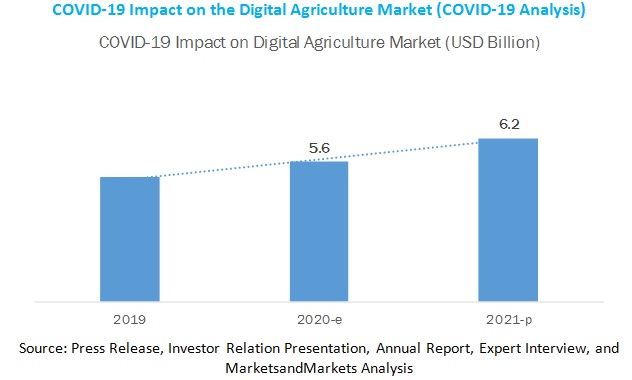
Increased farm mechanization and developing digital agriculture infrastructure are expected to increase the adoption of digital agriculture among the farmers. The COVID-19 impact on the market is estimated to be positive. Labor shortages and supply chain disruptions are expected to raise the need for digital agriculture, globally.
Download PDF Brochure: https://www.marketsandmarkets.com/pdfdownloadNew.asp?id=222616344
“Precision farming is the most attractive end-user industry in the digital agriculture market.”
The precision farming market is likely to increase in the long term after the COVID-19 outbreak, as precision farming makes it possible to monitor the state of the crops while not being physically present through the usage of automation, minimizing the need to contact other people, which is crucial during these times. This farming is an approach where inputs are utilized in precise amounts to get increased average yields, compared to traditional cultivation techniques. However, in the short term, COVID-19 would affect the market and the growth of the market would be relatively slower in the first and second quarters of the year 2020 due to economic slowdown and inflation.
These practices save time and costs: reduce fertilizer and chemical application costs, reduce pollution through less use of chemicals. Also, they help in monitoring the soil and plant physiochemical conditions: by placing sensors to measure parameters such as electrical conductivity, nitrates, temperature, evapotranspiration, radiation, and leaf and soil moisture, so that the optimal conditions required for plant growth can be achieved. These factors help to obtain a greater output with limited labor force during this pandemic situation where there is a shortage of labor and thus would help in a regular supply of food, thereby ensuring food security.
“Farm labor management remains the worst affected market during COVID-19.”
With the COVID-19 outbreak, farm labor management remains worst affected in the digital agriculture industry. The pandemic has a significant negative impact on the livelihoods of millions of workers engaged in export-oriented, labor-intensive agricultural production in developing countries. The pandemic may also have a serious impact on processing due to labor shortages and the temporary cessation of production. For example, according to International Labour Organization (ILO) 2020, Europe’s agricultural sector is facing dramatic labor shortages due to border closures that prevent hundreds of thousands of seasonal workers from reaching farms that rely on their labor during the harvest period. The impact on the sector is expected to be long term. Many major European agricultural producers, including France, Germany, Italy, Spain, and Poland, are particularly vulnerable. According to Coldiretti, the Italian organization representing farmers, over a quarter of the food produced in the country relies on approximately 370,000 regular seasonal migrant workers.
Request for Customization: https://www.marketsandmarkets.com/requestCustomizationNew.asp?id=222616344
Key Market Players
Some of the major players in the market are DTN (US), Farmers Edge (Canada), Taranis (Israel), Eurofins (Luxembourg), and AgriWebb (Australia). DTN specializes in subscription-based services for the analysis and delivery of real-time weather, agricultural, energy, and commodity market information. The company mainly operates through four business segments, namely, agriculture, energy, weather, and financial analytics. The company offers different smart farming systems through the agriculture segment. Its agriculture segment provides an analysis of commodity markets; hyper-local weather and disease insights to guide planting, growing and harvesting operations to farmers and agribusinesses; and a real-time pulse on the industry so they are aware of the trends and how they may affect their operations.
The impact of COVID-19 on DTN is low as of now, but after the second to third quarters of the year 2020, the demand is projected to be revived as the adoption of smart farming technologies will help avoid contamination COVID-19 and require less labor. This crisis has impacted the infrastructure funding in the company due to economic slowdown and recession; industry players are reluctant to invest in the company. The company is witnessing limited disruptions in the supply chain for raw materials such as software and hardware components as the company has its plants still in operation. Despite various challenges and hindrances faced by the company, DTN is delivering essential services globally by providing digitalized farming solutions. Therefore, DTN’s supply and demand are not affected significantly in the digital agriculture division and the impact on business is moderate as of now.